May 22, 2016

Day 7 - On Land Recreation and alternate uses of teapots; Rod


It was a day of recreation for Quijote crew.  It started with a marathon sleep-in.  Bob and I had a day long hike in mind that the books described as steep, slippery, and difficult - just what we needed to shake our limbs out of a week of lethargy.  Since the route was described as a couple of hours each way, there was clearly no need to get going early.  We slept in, had a leisurely breakfast, and relaxed the morning away.  Then discovering that the day was getting away from us, we mustered quickly and Kay ferried us to shore.

Charging up the trail, it started off easy, then disappeared. We continued following what trail remained but it kept getting steeper until we found ourselves hanging off a moss covered wall with dead trees and decaying roots as our only hand holds.  A faint path clearly forged ahead, but my inner voice was telling me we were off route, following others who had no inner voice.

We turned around, worked our way back, and found the real trail, wide and lovely.  As advertised, it was steep in places, and certainly strenuous, but anyone who is accustomed to climbing in the Cascades with a good pair of boots would not find it difficult.

After an hour and a half we found ourselves at the top of the trail where the remains of a log cabin rested next to an impressive waterfall.  Bob drew my attention to tree scars and devastation from rocks that come down from above.  He noted that it wasn’t a very smart place to build a cabin.

Returning to the boat an hour or so later, it was sunny and warm.  We jumped at the chance to do laundry and take showers.  Each of us started with a teapot full of hot water and added it to a bucket with enough cold water from the stern shower to give us a bucket of warm water.  We lathered up and scrubbed ourselves and a weeks worth of dirty laundry, then hung the laundry on the life lines to dry in the sun and handed the bucket off to the next person.  There is a hot water heater on board that is warmed by the engine or shore power, but since we hadn’t used the engine or had the luxury of shore power for a couple of days, the tea pot method worked nicely.

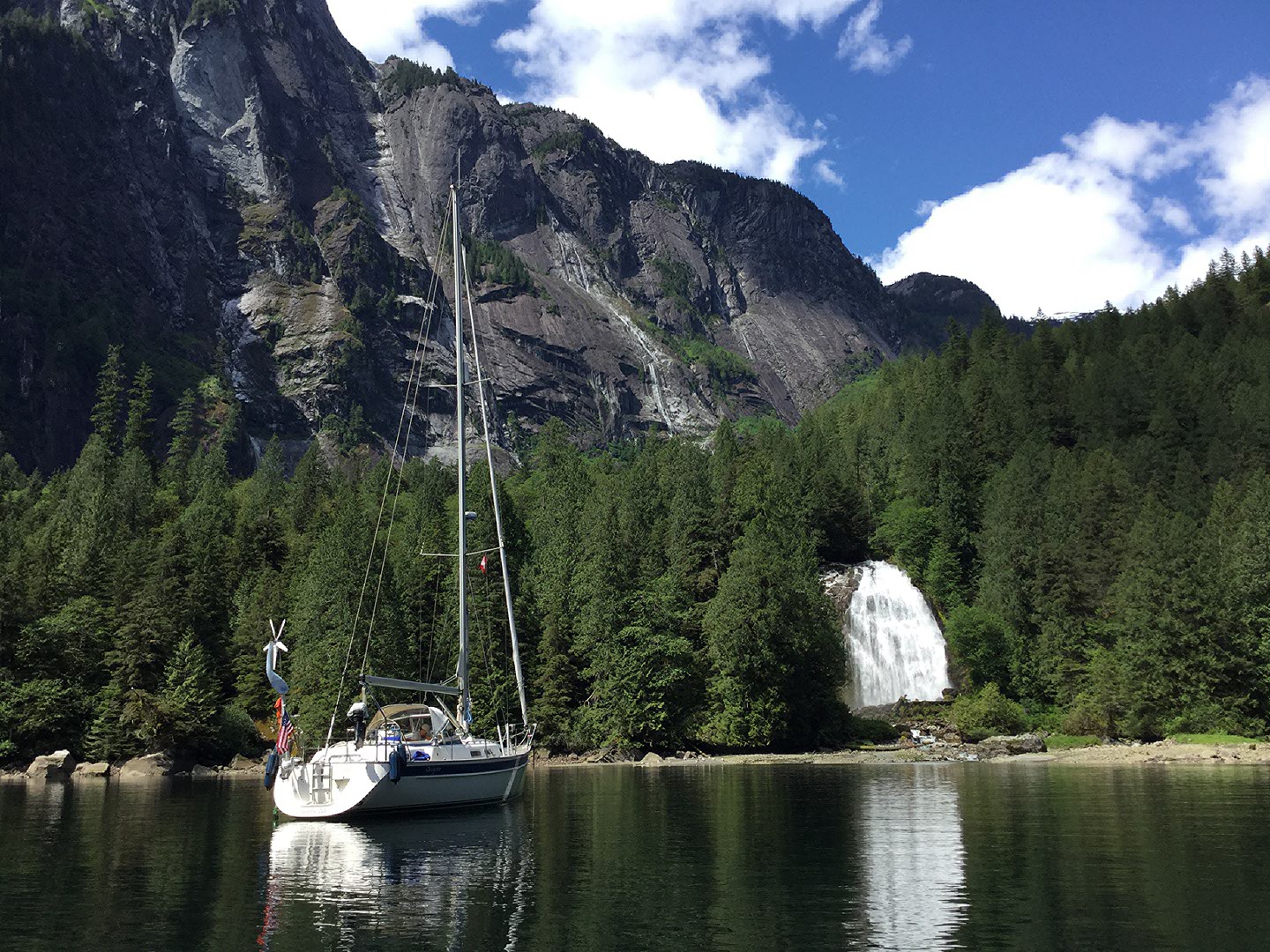
Day 6 - Anchoring in Princess Louisa Inlet; Rod

In a trip likely to be flush with first experiences, we can report one in the way we anchor at Princess Louisa Inlet.  There are several moorage options in the inlet.  The easiest is the public dock at the head of the bay.  It is also the most expensive; put $20/night  in the slot please.  The next easiest is to tie up to a mooring ball: $10.  These prices likely reflect their relative cost to maintain, although the funds are probably used for other things as well.  The inlet is mostly deep (sheer cliffs into the water and beyond in many places), so the anchoring techniques reflect that reality.

At the head of the Inlet is a waterfall: Chatterbox Falls.  For the purpose of the anchoring technique we used in the inlet any river outlet will do.  Where the rest of the inlet is deep, the head of the bay has a band near the shore line that is relatively shallow, although it does get deep quickly by comparison to most anchorages.  If you anchor in this shallow area close to shore and adjacent to the falls (or river outlet), the water outflow will keep the boat aligned perpendicular to the shore and will keep the boat away from the shore, even when the tide comes flooding in.  The boat will fish around a little at times, but the motion isn’t noticeable.  This was the first opportunity we had to practice the technique on this trip and it kept us pretty secure  for our two night stay.


The other option commonly used in the deep anchorages of British Columbia and southeast Alaska is to drop the anchor close to shore and tie a line from the stern to a ring or a tree on shore.  This technique keeps the boat from swinging and therefore allows more boats to be anchored in closer proximity.  We used this option extensively in the Mediterranean (where it is referred to as Med mooring).   Quijote has 600’ of 1/2” floating polypropylene line and a garden hose reel on board for this purpose.

Day 5 - Imaginary Thieves and Real Military; Rod


Thunder Bay!  Our staging point for Princess Louisa Inlet.  I had in mind a remote, secluded little bay; rarely visited by anyone but the occasional boater.  The reality is that the shore is lined with small cabins and a boat ramp or two.  It does offer protection from the wind and is probably popular with the yachties when summer gets into full swing.  For now it is nice to have the bay to ourselves, even if we do have to share it with the locals.

Tonight we have lasagna and green beans in mind with warm bread and good company.  Simon and Garfunkel are serenading in the background.

I drifted to sleep last night, imagining Canadian mercenaries drifting silently up to the boat in a small skiff and cutting our dinghy free.  I wondered whether we'd be able to buy another in Campbell River, and berated myself for not securing the dinghy with a steel cable and padlock.  In the bright light of day it all seems a little silly.  Fatigue and darkness take the mind in funny places - not that we won't secure the dinghy with lock and key at times along the way.

Crossing the Straight of Georgia yesterday was a mixed bag.  We exited Silva Bay at a leisurely  hour anticipating having to make way against the current in Georgia Straight.  This was by design as it would give us wind and current flowing in the same direction: a little slower, but much more comfortable.  The winds were predicted to die down in the afternoon for our crossing from Nanaimo to Malaspina Straight.

The night before, I dug out the book and recorded the coordinates of the corners of the Canadian Military exercise area (WG, known locally as Whiskey-Golf).  Then I ploted the corners as way points and plotted a course around the area on the chart plotter.  A typographical error in the book for the coordinates made me use Bob's iphone to pull up the coordinates on the internet.  (123deg 47'70" is not a legal coordinate and should be 123deg 47.70').  Later we saw that various sources plot the boundary of WG differently as well (see images).

Entering the Straight of Georgia that morning we were hit by 14-16 knot winds dead ahead and 3-4' chop (a very good thing the 2 knot current was not opposing) that gave us quite a ride, but not much opportunity to do any sailing.  I tried that game 25 years ago and found reference points on land stayed stationary.

As the day wore on the chop and the wind moderated and we glided north of Nanaimo toward the way point that would take us around the corner of Whiskey Golf.  Ten minutes or so after rounding that corner we were hailed by the Canadian Coast Guard on channel 16 informing us that we had entered an active military area and asking us to depart the way we had entered.  They told us we could transit the straight by going around the Balinas Islands.

We complied of course, but reviewing the material afterward in the Douglas book  shows 2000 yards of clearance inside the islands that we should have been able to use.   The chart shows the boundaries through the middle of the Balinas Islands, so that's the source we should have used.  Live and learn.

Day 5 - Wine Hitch; Bob


It seems like knots are everywhere on the Quijote.  Today Kay added another one with an original design born of necessity.  Her Wine Hitch ™ uses two loops with a center stay to form a secure harness for cooling wine in the cool waters of the Inside Passage.  This flash of inspiration came to Kay at the base of Chatterbox falls in Princess Louis Inlet.  Here a steady flow of cool water from the waterfall is ideal for cooling a bottle of Riesling. We think this knot will come in handy in the days ahead too!

(written by Bob)

May 20, 2016

Day 5 - Marine Perspective; Bob

Being in a boat offers me a totally new perspective in a literal sense.  Normally at home, I am in my home office which lacks a view of any kind.  When I take walks in my home city of Seattle, they are often in the neighborhood and offer "peek-a-boo" views at best.

This contrasts greatly with the 360 degree views that are available all of the time from the good ship Quijote.  Instead of looking a screen a few inches away, I am generally looking at a distance - for example looking at islands that are perhaps 500 yards away.  Of course my views are from a moving platform - the boat is never really steady.  And when the boat is underway, I am not always looking straight ahead as I would if I was the driver or a passenger in a car back in Washington. 

What are the effects of this "marine" perspective?  Well, the immediate impact on me from seeing things from a moving platform was seasickness.  But that was a few days ago and I am more used to it now.  Another effect on me is that when I am on land now I am fascinated by the detail at my feet.  The beached crab claw above provides an example.  My hunch is that since here is since the views from the boat are primarily distant, I am more inclined to look at nearby detail when on a hike.  Research continues!

(written by Bob Bennett)

May 19, 2016

Day 4 - Plotting our course; Bob


As a newbie to sailing, I have been keenly interested in how we plan out our daily sailing routes.   Captain Rod has our overall route planned out but each day we get into the nitty gritty of plotting our specific route out in great detail.  To do this, both high and low tech methods are used. 

In the image here you can see a compass is being used to compute out the distance of a proposed route on a paper chart.  The distance between the compass legs represents one nautical mile and the compass is "walked" along the route to get total distance.  5 steps of the compass would equal 5 nautical miles.  'Who cares what the distance is?' you might be thinking.  Well, distance takes time to cross in the boat and the Quijote can only go so fast.  If we know when we will reach a certain passage for example, we can be sure to get there at slack tide when the currents are minimal.   If we did not do this planning we might face a 9 knot current as we try to cross thru the passage -- which is faster than out boat could ever go against it.

High tech navigation aids on the Quijote include a Furuno navigation station that plots our current location on a colored digital map at all times.  This station is visible to whomever is piloting the boat and is constantly referenced.  Before each day's journey, waypoints are entered into the navigation station.  These come from consulting numerous other sources like guide books, paper charts, digital maps on a PC.  Each information source offers its own perspective on the complex coastline, indicating for example hazards, depth, shipping lanes.  Sometimes the information from two sources conflicts slightly and we have to choose which one to believe.  When underway, to keep us on our toes, we write down various datum into a paper logbook at each waypoint including barometric pressure, windspeed, engine hours logged and so forth.  Waypoint by waypoint we are making it up the coast!

(written by Bob Bennett)


May 18, 2016

Day #3, Nesting Birds - Kay

We anchored at Silva Bay this afternoon.  Silva Bay is a sweet spot off the east side of Gabriola Island. After taking the dinghy to town, well not town, really just the marina and some services, we are back on Quijote safe and sound. Lucky we didn't stay off board for a beer. We are sipping beers while snug in the cockpit with winds increasing to 14 knots, and gusts thus far up to 19 knots!

Enroute today we had time to waste before slack at Gabriola Passage. We choose to drift gently, no motor, no sails, along Valdez Island 100 yards offshore where we watched and listened to nesting birds, soaring eagles, sleek seals.  A special treat.

Motoring through Gabriola Passage at slack was a breeze.

After another long day, we all look forward to a long sleep.  Tonight it will be to the sound of howling wind and hard rains cleansing the decks.


Day 2 Avocado madness; Rod

Twelve avocados were perfectly ripe at the same time today.  What can you do?  When life feeds you avocados, make guacamole.  By the time you add cilantro, salsa, cheese and chips, you have enough nachos to feed an army.  Did that slow us down?  Of course not.We added tacos, a bottle of wine, and the berry pie that Pat sent us on our way with - all incredibly delicious.  Silence prevailed except for the occasional sounds of the marine life around us and the appreciative murmurs of culinary ecstasy by the Quijote crew.  A late evening sunset splashed the surface of the bay while we devoured our meal, stuffing ourselves as only the high energy lifestyle of outdoor adventuring will allow.

The latter point is, of course, so much rationalization for overdoing dinner.  Sailing is mostly a sedentary sport.  If we have many more meals like last nights, they will have to roll us off the boat.

We did get some exercise in Bedwell harbor yesterday.  After clearing customs we anchored by the shoreline and paddled the dingy to shore where we enjoyed hiking along a spectacular trail that ran along the shoreline for a mile or so before petering out where bluffs made passage by foot impossible.  It was so good to get out and stretch the lungs.


Day 1, Aleck Bay; Rod

A quiet start on a misty morning.  Quijote crew said their goodbyes and started north under gray skies and a light wind.  We were passed by the odd barge or two, a coast guard cutter, and several motor yachts, but for the most part the traffic was light and the passage largely uneventful.  Kay served up snacks as we plodded along, bucking a flood current, making 6 kts headway.

We rounded Partridge Point on the northwest shoulder of Widbey Island when things started to happen.  First the wind kicked up to 16 kts, then Bob turned green and fed the fish, and the sun came out.  Encourage by the former and latter events, and hoping to improve Bob's disposition, we hoisted sail and cut the engine.  It stayed sunny for the rest of the afternoon, the wind stayed fresh and steady at 12kts all the way to the anchorage, but Bob never did get his color back completely.  So much for the patch.  It was a little rough out on the Straight of Juan de Fuca.  Three cheers for Bob who will also be rounding Cape Caution with us.

We arrived at Aleck Bay in the early evening with just enough sunshine left in the day to enjoy dinner by.  A cacophony of birds filled the bay in fading fading light as the sun settled onto the horizon.

May 15, 2016

A fine send-off

May 15th found crew and family and friends at Golden Gardens giving the SV Quijote a fine send-off party. Food, greetings, exploring the map, bubbles, frisbee. Such a caring group of strangers and friends giving goodwill and blessings for safe travels.  A perfect way to start this journey.

The party is over.
It is quiet. Drizzle has settled in. The distant trees have softened edges. Everywhere is light greyness. Gentle rain on the dodger. Dusk. A perfect first night on Quijote. 

May 4, 2016

Food preparation


Kay has been organizing a list of what food items are needed for the big sailing trip up the Inside Passage.  Importantly she has assigned meals that each of us are responsible for.  Rod lent one me one of his two vacuum sealing machines and I am busy cooking meals that should be welcome fare up North.  The idea is to have meals that can be easily prepared while sailing.  In the photo you can see a home prepared meal that is about to be vacuum sealed!

May 2, 2016

Second of Two Crew Preparation Cruises

We enjoyed another fine weekend getting used to the boat and the cruising life last weekend.  This time it was Bruce, Lavanya and Jason on board.  We're two for two on the weather for these practice cruises.  It's hard to describe the weather for both weekends as anything short of glorious - sunny and windy; what more can a crew of sailors hope for?

We transited the locks in short order on Saturday morning and motored North past the south end of Whidbey Island dodging regatta boats that were floating aimlessly in the slack early morning wind.  Abreast of Everett the winds started to build until we were snorting along at over six knots under jib and mainsail.


Wanting to arrive at Langley before the marina office closed at 5, we used up our play time and headed in to dock and explore the town.

Langly has a small town feel to it, but the general store has ample provisions and the dock has great WIFI.  We stopped at a small beverage cafe to unwind a little and then found a trail down to the beach to get a little walking in.


Saturday was all about giving the crew time to become acquainted with Quijote and her various systems.  For lunch, Lavanya and Jason put together awesome grilled sandwiches and salad and we barbecued chicken on the stern rail for dinner.  The new griddle Kay added to the galley works really well.


Sunday started by anchoring outside the marina and, with more great cooking by the Lavanya-Jason duo, Bruce and I worked though the dinghy deployment and used the new outboard hoist to mount the outboard onto the back of the dinghy.  With a few practice runs of the dinghy around the boat, we filled our bellies with the fruits of L&J's efforts: a mushroom cheese scramble and toasted bread, granola, fruit and yogurt.  Awesome!

After a little attention to some odds and ends, jack lines, man overboard procedures, etc, We were under way again with a galloping 16 knot following wind - great conditions for spinnaker sailing!


Photos by Rod and Lavanya

April 22, 2016

Under and Over

Bob and I spent an afternoon taking care of odds and ends on the boat.  The first goal was to climb into the wet suit, swim under the boat, and check out the keel, rudder, and anodes.  I expected to learn as much from the diving as from looking at the underside of the boat.

I've been on more than one cruise where the prop got wrapped up in a poorly placed crab pot line (poorly placed being any location within fifty yards of my propeller).  The bloody things are everywhere.  When it happens, what are you going to do?  If you're in the south pacific, you go for a swim.  If you're in SE Alaska you suffer - or you have a wetsuit along.  The suit is new, so I wanted a trial run in friendly waters.  Getting into the suit is hot business on a sunny day, so it actually felt good to get into the water.  Unfortunately my weight belt is about half as heavy as it needs to be to let me under the boat.  That is exactly the kind of thing that a trial run is intended to find, so in that it was a brilliant success, even if I didn't accomplish anything else.  Next time.

Rod sneaking up on the water...

The second objective for the day was to run up the mast with Bob keeping a firm belay.  Here again I had two accomplishments in mind: install a new Windex (the boat has never had one under my ownership), and try out my new ascending system.  I tied my home built etriers (French for stairs) up the mast with the spare halyard.  The etriers are forty steps tied into 165' of nylon webbing to span the 55 foot mast.  You can see them in the next couple of photos.  Hoisting myself up one step at a time, Bob just had to belay me with the halyard winch on a redundant line (the topping lift).  I also clipped my harness into the steps periodically along the way.  Arriving at the top, Bob placed the necessary tools in a bag and I hauled them up with a tag line.  I installed the new Windex fairly quickly.  The Windex shows the angle of the boat with respect to the wind.  Then Bob lowered me to the deck and we were done.  It wasn't until we were cleaned up and put away that we discovered the shaft that goes on top of the Windex to keep the birds off of it.  It was lurking at the bottom of the box.  Hey!  What's this doo-hickey? Oh well; it'll wait.
You're going to trust your life to that knot?!

At 55 feet, it's only high if you think it is.  I keep telling myself that...
Photos by Bob Bennet

April 18, 2016

Charts are a wrap with help from our friends

The voyage from Fremont to Juneau will take us exploring the Inside Passage in-depth. Up fiords, circumnavigating islands, exploring shorelines and crossing expanses of open seas.  Although Quijote has excellent electronic navigation systems, having a full set of paper charts is not only a good back-up, it will be a daily event for the crew to review, explore and plan on the paper charts for the route ahead. 

With about 60 charts needed for this trip, it's not a minor expense to have a full set.  A big thank you to John Green and John Hastil for loaning us many of their charts to complete our set.  You'll both be with us on this trip!  Thanks for your encouragement, good will and huge savings!

April 13, 2016

We have ignition

Yes there are motors on the good ship Quijote!  There is a gorgeous diesel engine down below and this little 4 HP kicker motor for use on the dinghy.  In the looking down angle pic above you can see the motor stored on the back of the sailboat with a blue bucket full of water underneath.

Last weekend we could not get this little 4-stroke Yamaha outboard engine to start when were testing it out in Puget Sound.  So dockside yesterday, Rod and I rolled up our sleeves and checked out the two key variables in more detail; fuel and spark.  After taking a look at the spark plug and confirming fuel, we concluded there was nothing wrong with either.  So we tried starting the motor and it came to life.  The good news is that the motor started - quite easily.  But we wish we knew why we had not been able to start it out on a pitching dinghy.

April 12, 2016

Support and Positive Vibes


This picture of the good ship Quijote passing thru the Ballard locks in Seattle was taken by one of the many people who are supporting our upcoming trip is unexpected ways.  In this case, the photographer was a friend of Sue and Bob named Kelly.  She had assisted that day by dropping us off (and picking us up) at the marina where Rod keeps the boat.  Then she surprised everyone by showing up at the locks and waving us off on one of our practice sailings!

The point is, there are many people who are helping with the upcoming trip.  As a reader of this blog, you may be one of them!  We thank each of you, even if you are just sending positive thoughts our way. 

You may notice that we are privileged to be going on a beautiful sailing boat.  In the image above we are passing thru the "small locks" in Ballard which are really nifty since the wall that we tie up to actually slides up and down with the changing of the water level!  This means we do not have to loosen/tighten the lines as the boat is raised or lowered.  Somebody was clearly thinking when they designed those locks.....

April 11, 2016

The Planning Continues


A trip like takes a tremendous amount of planning.  Recently the crew met over dinner at Frederic and Marta's lovely home in Redmond, WA. to get to know each other and discuss important trip details. 

In this photo we see our Captain Rod - pouring over a map.  That is Fredric on the left speaking to Kay.  Sue is partially seen in the background.

We also had an incredible dinner that night and realized what great cooks both Frederic and Marta are! 


The first of two preparation cruises for the IPT

We put together a familiarization cruise last weekend in preparation for our Inside Passage trip.  Rod, Kay, Bob, Sue, Frederic and Marta participated - great crew, great weather.  Almost everything worked out as planned.  Six people on board was cozy, but it wasn’t so bad that it felt too crowded.

Frederic and Marta joined us and departed at shilshole, but the delay in the start time worked out well because it gave the fog time to dissipate.

On the way through the locks we tied up next to a woman who had bought a boat for herself for her 30th birthday and was also heading to Liberty Bay with a flotilla of a dozen CYC boats.  That concerned us a bit as we imagined hoards of people and boats competing for dock and anchor space on a gorgeous Saturday afternoon, but we needn't have worried.  Liberty Bay has ample transient moorage and acres of anchorage.  We never even saw them again.

We practiced anchoring, using the jack lines, did a man overboard drill, pumped up the dinghy, did plenty of sailing in lovely sunny, windy weather, and got used to cooking onboard and on the barbecue.  Everyone slept comfortably and got along famously.  

On the way back as we were transiting the locks the tide was so low it was difficult to see all the tourists that normally look down from above us.  Suddenly flowers started raining down on the boat from above.  Someone was showering the decks with purple flowers.  It wasn’t until the level of the water in the locks had risen and we were almost up to the level of the crowds that we noticed Frederic and Marta lurking in the background with grins painted on their faces.  What a hoot those two are.  They had driven around from Shilshole to greet us as we transited the locks.  This week they're off to France.

The only thing that didn’t work well was the outboard motor.  We never did get it to start, so I’ll have to figure that out this week.

Inside Passage blog Introduction

This is a sailing blog for our Inside Passage Trip on the Sailing Vessel Quijote (our so called IPT on SVQ).  Planning is still under way and the boat is moored at Northlake Marina on the north end of Lake Union.  On the 15th of May, we will transit the Ballard Locks and dock the boat in Seattle's Shilshole Marina before an early morning departure on the 16th to head north.  Going North to Alaska! Our furthest point North will be Glacier Bay with a rough return date of August 27.

The trip has been broken into a dozen segments that range in duration from 4 to 14 days.  The segments are intended to have easy access for crew who will join and depart the trip.  At this point there is still ample opportunity to join the fun.  We have the desired two persons minimum for each segment thanks to Kay who signed on for the entire trip.  A few of the segments are full, but many of the remaining segments have room for two or three crew, so please contact Rod (that's me) at roderick.g.mercer@gmail.com if you'd like to inquire about participating.

The primary requirement is that crew members be easy to get along with.  Flexibility, consideration, tidiness, a desire to learn and to contribute in whatever way you can go a long way toward making the trip pleasant for everyone.  Sailing and cruising experience is also helpful, but not necessary.

The primary costs include fuel, provisioning, and occasional moorage at marinas.  These costs will be figured on a per day basis and divided by the number of crew for that day.  Crew are responsible for personal equipment and for transportation to and from the points of access.

We have two spreadsheets that provide detail on our planning.  The first is a day by day estimate of our intended stops.  The document is likely to change under way as the trip unfolds.  Extra days are padded into the itinerary every few days to allow for days to chill, explore or be delayed by weather or mechanical problems.  It's just a rough guess that allows us to plan for meeting crew along the way, but there is little doubt that it will evolve as we go.

https://www.icloud.com/numbers/000ivvQtPdSAI1JU4YcO-SZoQ#Inside_Passage_Itinerary_2.0

The second spreadsheet shows the twelve segments of the trip chosen for convenient crew access.  There will be a two week break in the middle of the trip with seven segments before and five segments after.  Each row of the spreadsheet is dedicated to a segment that shows where and when we'll arrive or depart and how many crew are currently committed to the segment.  The boat sleeps seven, but six is the maximum crew size that I'd like to accept.  Three or four is optimal.

https://www.icloud.com/numbers/000s2gDj2AcBcqsNgzP7nXx1Q#Inside_Passage_Segments_2.0

The boat is a 2007 Hallberg Rassy 37 of good ocean sailing pedigree.  It is in excellent condition and quite comfortable for its size.  I've owned the boat since November 2014.  I've been offshore a couple of times on other boats, down the west coast and across the Atlantic, but the bulk of my cruising experience has been in coastal bare boat charters: Jan Juans, Gulf Islands, Sea of Cortes, Thailand, Vietnam, Croatia, Greece.